Why true luxury begins with how a home lives, not merely how it photographs.
When designing a mansion of 10,000 square feet or more, one of the most important questions is deceptively simple:
Should the home be designed from the inside out, beginning with function and flow?
Or should it be designed from the outside in, beginning with the exterior form, façade, and architectural image?
The best answer is neither extreme.
A true mansion should begin with the life it must support, then the architecture should be shaped around that life with discipline, proportion, site awareness, and beauty.
In other words, the best estate homes are usually designed inside-out first, but never inside-out only.
At this level, luxury is not merely size. It is not simply marble, chandeliers, imported stone, tall ceilings, or an impressive driveway.
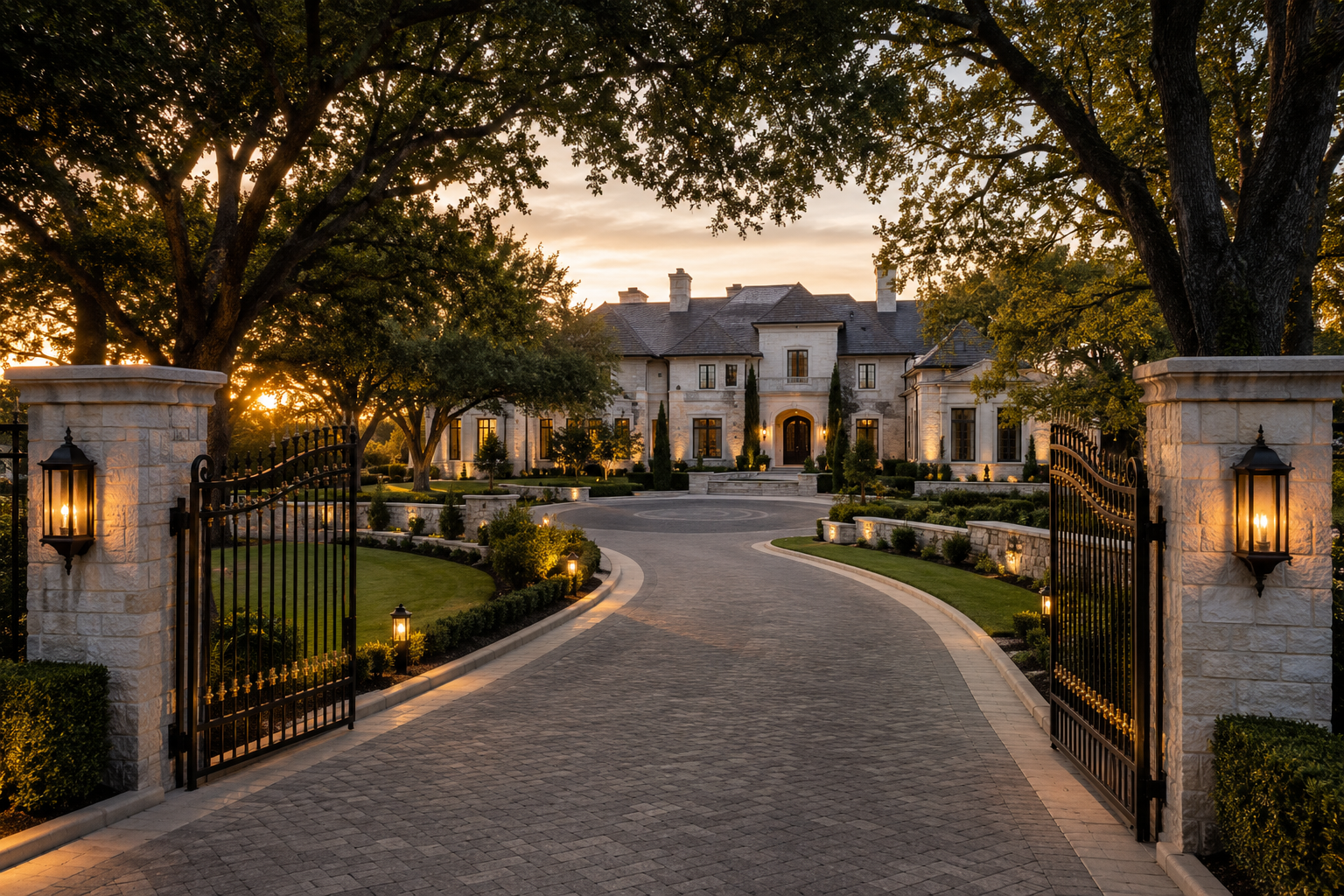
Luxury is revealed in how the home lives: how gracefully it receives guests, protects privacy, and guides movement from public entertaining areas to more intimate private spaces. It is also found in the way service functions occur discreetly, without disturbing the owner’s experience, and in how the architecture, land, interiors, and infrastructure come together so naturally that the entire estate feels inevitable.
A mansion that only photographs well is not enough. A true estate must live well.
The Problem With Designing the Exterior First
Many mansion projects begin with an image.
The owner wants a French château. A Mediterranean villa. A Georgian estate. A modern glass mansion. A Hill Country modern residence. A limestone-and-slate manor with a grand motor court.
There is nothing wrong with having a strong architectural vision. In fact, a mansion needs one.
The danger comes when the exterior fantasy becomes the master, and the interior plan becomes its servant.
That is how large homes end up with impressive façades but awkward interiors. Rooms are forced into leftover spaces. Hallways become too long. Windows are placed for exterior symmetry but fail the interior. Bedrooms sit too close to entertaining zones. Kitchens are too far from terraces. Service areas interrupt luxury spaces. Garages dominate the front elevation.
The result may be expensive, but it is not refined.
That is the difference between a large house and an estate-quality residence.
Flow Is the New Luxury
In mansion design, flow is luxury.
At 10,000 square feet or more, poor circulation is magnified. A bad decision in a normal home may be mildly inconvenient. A bad decision in a mansion may create thousands of square feet of daily irritation.
A well-designed estate should make movement feel natural.
Guests should arrive, enter, and understand where to go. The family should move comfortably between the garage, kitchen, family room, bedrooms, office, gym, and outdoor living areas. Caterers and staff should function without becoming part of the evening’s entertainment. Pool guests should have access to a bath without wandering into the private wing. Deliveries should not disrupt the formal entrance.
The most refined homes are not merely decorated. They are orchestrated.
The Mansion Should Begin With a Lifestyle Program
Before the exterior is finalized, the design team should understand how the owner lives.
This requires more than a room list. It requires a lifestyle program.
Key questions include:
How formal is the owner’s lifestyle?
How often does the owner entertain?
Are gatherings intimate, charitable, business-related, family-oriented, or large-scale?
Does the home need a catering kitchen or prep kitchen?
Will there be staff, drivers, vendors, or a house manager?
Should the owner’s suite be secluded?
How many guest suites are needed?
Will adult children, parents, or long-term guests stay in the home?
Does the owner work from home?
Is the home also a wellness retreat?
Does the design need a theater, gym, sauna, wine room, golf simulator, music room, lounge, or collector garage?
Should the house support aging-in-place?
What level of privacy and security is required?
These questions establish the design logic of the estate.
Without this discipline, a mansion can become a parade of expensive rooms rather than a coherent way of living.
Public, Private, and Service Zones
A mansion should usually be organized into clear zones.
The public zone includes the foyer, gallery, formal living room, dining room, powder rooms, bar, lounge, wine room, terrace, and other entertaining spaces.
The private family zone includes the everyday kitchen, family room, breakfast area, bedrooms, family lounge, laundry, mudroom, and casual outdoor spaces.
The owner’s zone may function almost like a private residence within the residence. It may include a vestibule, sitting room, bedroom, dual closets, spa bath, morning bar, private terrace, gym access, or executive office.
The guest zone should feel gracious but not intrusive. Guests should have privacy without being embedded too deeply in the family’s daily life.
The service zone includes the prep kitchen, pantry, storage, mechanical rooms, laundry support, vendor access, trash handling, package delivery, staff work areas, and maintenance paths.
When these zones are properly arranged, the home feels calm, organized, and elegant.
When they are not, even a magnificent mansion can feel chaotic.
The Site Is a Co-Equal Design Driver
Designing from the inside out does not mean ignoring the site. For a mansion, the land is a major part of the architecture.
The architect should study the street approach, gate location, driveway path, privacy, sun orientation, views, topography, drainage, trees, outdoor living areas, guest parking, pool placement, service access, and security perimeter.
A mansion should never feel like a large object dropped onto a parcel of land. It should feel composed with the property.
In North Texas, where estates may sit on large suburban lots, golf-course lots, gated community parcels, or more open acreage, site planning becomes especially important. Shade, privacy, landscape screening, water features, terraces, courtyards, loggias, and outdoor rooms can transform a large house into a resort-like estate.
The best homes do not merely occupy land.
They command it gracefully.
The Arrival Sequence Matters
A mansion begins long before one reaches the front door. The experience starts at the gate, continues along the driveway, unfolds through the landscape reveal, and builds through the motor court, front elevation, entry, and finally the foyer.
A proper arrival sequence creates anticipation. It gives the home ceremony without becoming theatrical.
The approach should feel deliberate. The driveway should not feel like an afterthought. The garages should not dominate the composition. The front door should be legible. The motor court should feel generous but not commercial. The landscaping should frame the architecture rather than compete with it.
This is where exterior thinking becomes essential early in the design process.
The home may begin with the lifestyle program, but the estate experience begins with arrival.
Exterior Massing Matters More Than Decoration
For large homes, massing is more important than ornament.
Massing is the three-dimensional composition of the home: the main body, wings, rooflines, terraces, courtyards, towers, garages, porches, loggias, and secondary structures.
A refined mansion has hierarchy. The main volume feels important. The entry is clear. The wings feel subordinate. The rooflines are controlled. The windows have rhythm. The garage does not overpower the house. The architecture has confidence without clutter.
A mansion becomes visually weak when it relies on too many decorative gestures: random gables, mismatched windows, oversized columns, unnecessary turrets, exaggerated balconies, and roofline chaos.
At 10,000 square feet or more, restraint is powerful.
The grandest homes rarely need to shout.
Interior Design Should Begin Early
Interior design should not begin after the architectural drawings are complete.
For a mansion, that is too late.
The interior designer should help shape furniture layouts, room proportions, ceiling heights, lighting plans, window placement, fireplaces, art walls, millwork, kitchen workflow, bathroom layouts, closet design, material transitions, acoustic comfort, and smart-home controls.
A room can look impressive on a floor plan and fail in real life.
A great room may be too large for intimate conversation. A dining room may not allow enough clearance around the table. A bedroom may have poor furniture walls. A foyer may be dramatic but acoustically harsh. A theater may be in the wrong location. A wine room may become a showpiece with technical problems.
Luxury must be beautiful, but it must also be usable.
The finest interiors are not merely applied to architecture. They are integrated with it.
Invisible Infrastructure Is Part of Luxury
A mansion is not just a beautiful residence. It is also a complex building system.
HVAC zoning, plumbing runs, electrical loads, smart-home systems, lighting controls, security cameras, access control, gate systems, backup generators, elevators, AV systems, wine cooling, pool equipment, mechanical rooms, Wi-Fi coverage, water filtration, acoustic isolation, and humidity control should all be considered early.
When infrastructure is planned late, it often damages the design.
That is when soffits appear in awkward places. Mechanical noise interrupts quiet rooms. Service technicians need access through beautiful spaces. Wi-Fi fails in remote wings. Lighting controls become confusing. Theater sound bleeds into bedrooms. Wine rooms underperform.
At the estate level, invisible infrastructure is luxury.
The best mansions make complexity disappear.
Outdoor Living Should Be Architecture, Not Decoration
For modern luxury homes, outdoor living is not an accessory. It is part of the residence.
The pool, spa, cabana, outdoor kitchen, dining terrace, fire pit, garden rooms, putting green, sport court, guest house, pool bath, and covered loggias should be planned with the home from the beginning.
The kitchen should relate to outdoor dining. The family room should connect to casual outdoor living. The entertainment spaces should connect to terraces. The owner’s suite may need private outdoor access. Guests should be able to enjoy the pool without entering private family spaces.
A mansion with poor outdoor planning can feel incomplete, no matter how expensive the interior finishes are.
Resale and Long-Term Flexibility Still Matter
A custom mansion should serve the owner first, but ignoring long-term flexibility can be costly.
The home should consider aging-in-place, elevator access, first-floor living options, guest suite flexibility, adult children, elderly parents, staff possibilities, technology upgrades, and future resale.
Luxury buyers often expect a coherent architectural style, strong curb appeal, ensuite bedrooms, a gracious owner’s suite, large kitchen plus prep kitchen, indoor-outdoor living, wellness amenities, generous garage capacity, storage, privacy, and excellent natural light.
Personalization is part of custom design. But extreme personalization can make a mansion harder to enjoy, maintain, or sell.
A true estate should feel personal without becoming impractical.
The Best Design Process
The strongest mansion design process is iterative rather than strictly linear.
A serious design team should move through these steps:
Define the estate vision.
Study the site.
Create the lifestyle program.
Map room adjacencies.
Develop public, private, and service circulation.
Test exterior massing.
Integrate interior design early.
Coordinate engineering and infrastructure.
Develop landscape and outdoor living.
Refine until the home feels inevitable.
The word “inevitable” matters.
The best mansions do not feel forced. They feel as though the floor plan, exterior, site, interiors, and landscape could not have been arranged any other way.
Final Thought
So, should a mansion be designed from the inside out or outside in?
The answer is both, but in the right order.
Start with the life the home must support. Understand the site. Develop the floor plan and circulation. Shape the exterior massing in parallel. Integrate interiors, landscape, service flow, and engineering early. Then refine until the home lives beautifully and presents itself with architectural authority.
A mansion that only looks grand is merely large.
A true estate lives grandly.
And that is the real distinction.


Leave a Reply