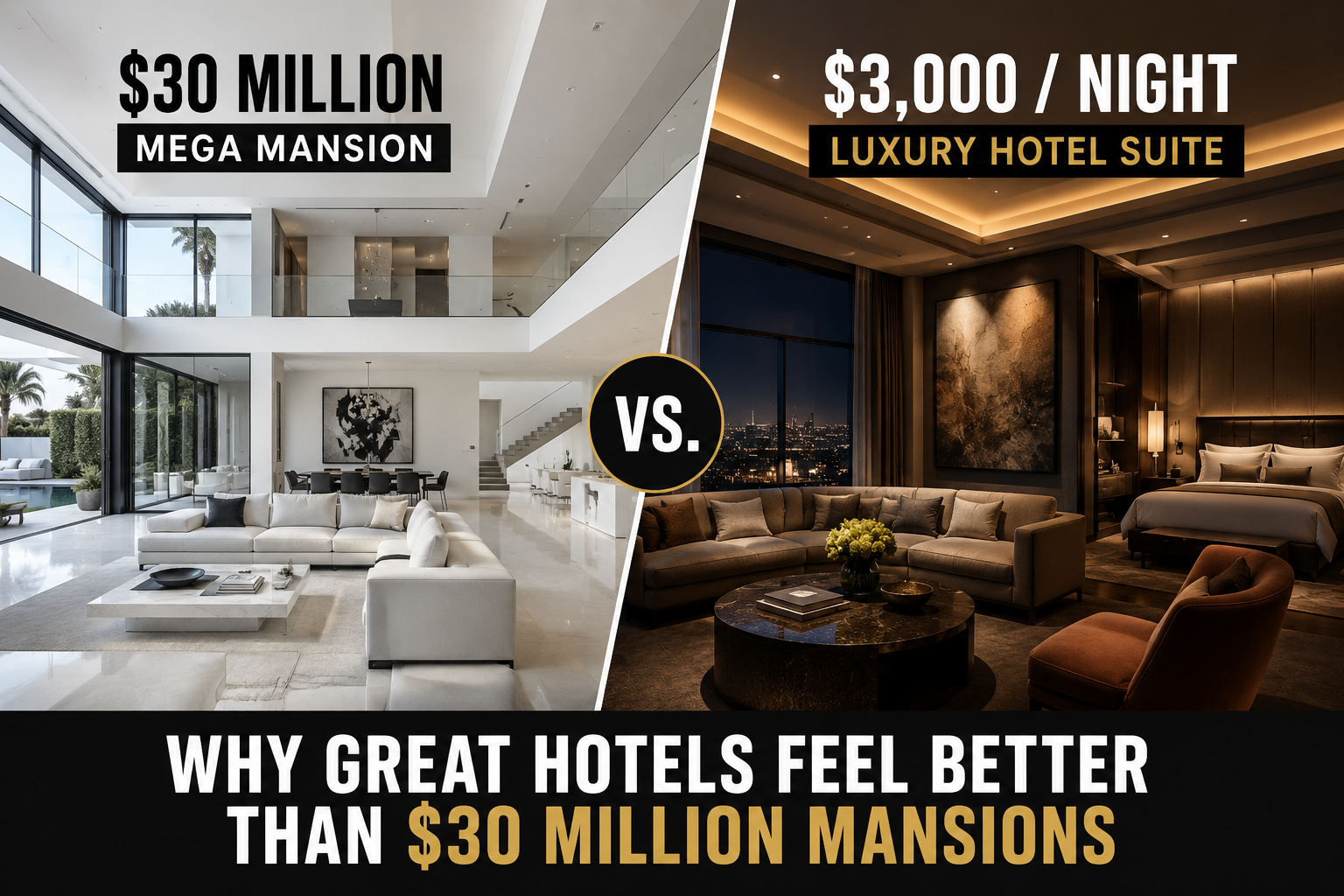
Spend enough time looking at new luxury homes and you start noticing an odd contradiction. Some of the most expensive houses in America can feel strangely generic. Calacatta marble. White oak. A wall of disappearing glass. A few pieces of bouclé furniture. Perhaps a floating staircase if the developer is feeling adventurous. Everything is expensive. Everything photographs beautifully. Six months later, you may struggle to remember which house was which.
Then you walk into a really good hotel.
Not simply a costly hotel, and certainly not every five-star property. I mean one of those places where somebody has clearly thought about what happens after the photographer leaves. The light is different at breakfast than it is at 10 p.m. The chair is where you instinctively want it to be. The room reveals the view at the right moment. The materials feel better when you touch them than they looked in the rendering. The technology is present but does not demand attention. Even the route from the bed to the bathroom at night seems to have been considered.
“Calm does not come from beige. It comes from solving circulation, landscape, furniture, and use as one system.”
That is the useful idea behind the Five By Nine video that started this conversation. Hotels can operate as proving grounds for design ideas that later migrate into upscale houses and condominiums. In 2026, there is now unusually concrete evidence for that argument. Marriott is not merely selling the familiar hotel mattress or branded bathrobe. Its Design Shop is offering furniture and décor explicitly translated from hotel environments into residential products. W Hotels Living takes cues from W New York–Union Square; Marriott says a JW Marriott Living collection inspired by JW Marriott Hotel Tokyo is due in fall 2026. The hotel-to-home pipeline has become literal retail.
But I think stopping there misses the more interesting story. The pipeline now runs in both directions.
The same designers move between mansions, restaurants, hotels, yachts, branded residences, furniture collections, and luxury retail. Hospitality clients are asking for rooms that feel less corporate and more like private residences. Homeowners are building spa suites, private bars, treatment rooms, club-like lounges, guest wings, concealed service corridors, and resort-grade outdoor environments. Branded residences collapse the distinction almost completely. At Aman Residences Tokyo, Yabu Pushelberg applied the design language of one of the world’s most influential hospitality brands to 91 private residences with hotel-like amenities including private dining, a tea room, library, media rooms, and an extensive spa. Is that a home borrowing from a hotel, or a hotel experience redesigned as a home? At this level, the distinction is becoming academic.
Architectural Digest’s 2026 forecast helps explain the aesthetic side of this shift, but AD should be understood correctly. It is enormously influential as a credentialing institution and cultural amplifier, not necessarily as the laboratory where every trend begins. Its 2026 forecast identified a move toward stronger self-expression: saturated color, decorative trim, dimensional walls, custom tilework, and highly specific wellness spaces. That is useful evidence because AD is seeing these decisions across its network of designers and affluent clients. It tells us when an idea has accumulated enough momentum to become part of the luxury conversation.
If I wanted to know what may be upstream of that conversation, however, I would also watch Milan. Wallpaper’s reporting from Salone del Mobile 2026 picked up lacquer moving into upholstered furniture, sculptural dining tables becoming architectural objects, tactile wall treatments, dimensional tile, and a stronger role for collectible design. Those are the sorts of product and material signals that can appear in a hotel suite or private house before the average luxury buyer has a name for them.
And if I wanted to know what hotel developers are actually commissioning rather than merely admiring, I would watch trade publications such as Sleeper and Hospitality Design. Their 2026 hotel-opening coverage shows the same pressure toward adaptive reuse, local craft, wellness, historic character, and a more residential sense of intimacy. The important point is that there is no single oracle anymore. Architectural Digest may tell you what has become culturally prestigious. Milan may show you what designers and manufacturers are experimenting with. Hospitality trades reveal what developers are putting into real projects. Social media then adds another layer: buyer reaction in public.
“Architectural Digest can tell you what has become culturally prestigious. A buyer-side critic can tell you why the house still does not work.”
This is where Arvin Haddad becomes more interesting than his follower count alone would suggest.
Haddad is not competing with Architectural Digest on the same field. AD usually asks, in one form or another, whether a space represents significant design. Haddad has built his brand around a more transactional question: would you want to own this house after the drone shot is over? His current site says he has spent more than 10,000 hours analyzing residential real estate, critiqued more than 1,500 luxury homes, observed hundreds of ultra-luxury showings, and organized his approach around ten principles of home quality. His videos repeatedly return to flow, orientation, land use, privacy, room relationships, maintenance, resale appeal, and the difference between spectacle and livability.
That is not interior design criticism in the traditional sense. It is closer to residential user-experience testing.
And that buyer-side perspective matters because luxury media has historically had a structural bias toward presentation. The home is staged. The light is controlled. The camera route is selected. The listing agent explains why every unusual decision is actually a feature. The audience is encouraged to admire. A critic who pauses the tour and asks why the kitchen is on the wrong side of the house, why guests must cross a private zone to reach the pool, or why 25,000 square feet somehow produced an undersized family room is performing a different function. He is testing whether the design survives contact with actual ownership.
“The real hotel-to-home lesson is not what to buy. It is what the designer solved.”
For ultra-high-net-worth families, that way of thinking can become even more consequential. Once a family owns several residences, design stops being only a question of taste. It becomes a portfolio problem. How consistent are the security standards? Can household staff operate without dominating family spaces? Are AV, lighting, access control, and environmental systems maintainable across properties? Which rooms are actually used? What happens when older family members visit? Can a property absorb large-scale entertaining without making daily life feel like living in an event venue? Does the architecture support privacy without turning the house into a bunker? These are questions a traditional shelter magazine may admire around, but an owner representative or family office eventually has to solve.
The mansion-to-hotel side of the loop is already visible in some of the private residences getting attention in 2026. George Yabu and Glenn Pushelberg’s own Amagansett beach house is a useful example precisely because its designers work across both residential and hospitality projects. The house was designed around protected dunes, borrowing spatial thinking from yacht design. Daily life is concentrated on one principal level; glass walls disappear at a corner so the deck reads as an extension of the interior; furniture is selected for durability and flexible use rather than display alone. That is the kind of residence a hotel designer can learn from: calm does not come from beige. It comes from solving circulation, landscape, furniture, and use as one system.
“A $30 million house deserves the same test as a $3,000-a-night hotel room: does it still work after the photographer leaves?”
Adam Lippes’s newly published Fifth Avenue mansion points in almost the opposite visual direction. It keeps the carved wood, marble fireplaces, ornamented ceilings, antiques, and historical gravity of an 1886 residence, then loosens the atmosphere with slipcovers, sheers, pattern, and an intentionally more relaxed mix. The lesson for hospitality is not that every hotel should become a Gilded Age townhouse. It is that heritage does not have to be embalmed. A historic building can retain its architectural authority while the furnishings make it comfortable enough to inhabit rather than simply admire.
Rosewood Amsterdam makes the same case from the hotel side. Studio Piet Boon describes the former Palace of Justice as layered, eclectic, residential in tone, and filled with stories; the hotel includes five large ‘Houses’ and more than a thousand works of art. That word—residential—is increasingly important. The best hotels are borrowing the emotional logic of homes even while homes borrow the service model of hotels.
So what should an affluent homeowner take from all this? Probably not a shopping list.
Copying the velvet headboard from a W Hotel or the stone palette from an Aman property is the easiest and least interesting version of hotel-inspired design. The real lesson is to study what the designer solved. How does the room handle arrival? Where does the eye land? Does a seating group make sense for two people as well as eight? Can you dim the room without turning it into a cave? Does the kitchen disappear when entertaining without becoming useless during breakfast? Are service functions easy for staff but visually quiet for the family? Does a 15,000-square-foot house still have places where two people can have a conversation without feeling as if they rented a convention center?
“The new luxury hierarchy is moving from visible expense toward resolved experience.”
This is also where North Texas luxury real estate has an opportunity. Dallas, Plano, Frisco, Westlake, and other affluent submarkets are increasingly capable of supporting extremely sophisticated residential work, but the region still produces its share of large houses where price, square footage, and imported finishes are expected to carry the design. A hospitality-grade approach would ask more demanding questions. What is the arrival sequence in 105-degree August heat? Where does the west sun hit at 6 p.m.? Can indoor-outdoor living work in North Texas beyond a perfectly staged spring afternoon? Does the landscaping create privacy from neighboring lots without turning the rear elevation into a hedge wall? Is there a true service path for caterers? Does the media room have serious acoustics, or merely a very large screen? Those details are not glamorous on a listing sheet. They are exactly what separates expensive construction from resolved luxury.
The most important 2026 trend, then, may not be lacquer, fringe, marble, or any particular sofa shape. It is the convergence of residential and hospitality design into a common discipline of experiential living.
Hotels are learning to feel like exceptional homes. Homes are learning to operate like private resorts. Furniture companies and design fairs supply the material vocabulary. Publications such as Architectural Digest and Wallpaper decide which ideas receive cultural oxygen. Hospitality trades show which ideas survive development budgets and operations. Critics such as Arvin Haddad add the buyer’s objection to a conversation that once consisted mostly of praise. Branded residences make the boundaries even harder to see.
And perhaps that is why the best hotel rooms sometimes feel better than houses that cost ten times as much. A good hotel cannot rely forever on the sales pitch. Eventually somebody has to sleep there, use the bathroom, find an outlet, close the drapes, order breakfast, take a meeting, live out of the closet, and decide whether the room still feels good on the third day.
A mansion deserves the same test.
50Plano Luxury Design Lens: What to Watch Through 2030
| Direction | What It Means |
| Residentialization of hospitality | More suites and public spaces will be planned around the intimacy, layered furniture, libraries, art, and spatial variety of sophisticated private homes rather than standardized hotel language. |
| Hospitality-grade private homes | UHNW residences will continue adding service circulation, wellness suites, serious food-and-beverage spaces, staff infrastructure, and invisible technology borrowed from resorts and private clubs. |
| Personal expression after beige quiet luxury | Neutral palettes will not disappear, but the luxury signal is shifting toward rooms with memory: color, trim, bespoke surfaces, antiques, collectible furniture, and culturally specific art. |
| Collectible design as architecture | Furniture, lighting, and objects increasingly function as spatial interventions rather than accessories. Milan 2026 is a strong leading indicator. |
| Buyer-side quality criticism | More affluent buyers will expect someone to challenge flow, orientation, privacy, maintenance, and resale logic rather than simply validate the aesthetic brief. |
| Branded-residence convergence | The hotel/home distinction will blur further as hospitality brands, designers, and service models move directly into private residences. |
| Invisible technology | The more sophisticated the home becomes, the less the owner should have to think about the technology. AI, AV, lighting, climate, and security will increasingly be judged by orchestration rather than gadget count. |
A Buyer/Owner Framework: Steal the Thinking, Not the Furniture
1. Arrival and spatial sequence — Ask what the house reveals, and when. A good property should not spend its best view in the driveway or force every visitor through private family space.
2. Human scale — Large rooms still need furniture groupings, ceiling transitions, acoustics, and lighting that make two or four people feel comfortable.
3. Day-to-night lighting — Evaluate the property after sunset. A house designed only for daytime photography is unfinished.
4. Service without intrusion — Catering, housekeeping, deliveries, maintenance, and staff movement should work without turning the family into spectators of operations.
5. Wellness that will actually be used — A cold plunge, sauna, treatment room, gym, or meditation space should be located and designed around routines, not the amenity checklist.
6. Technology as infrastructure — Control systems should be resilient, maintainable, intuitive, and discreet. A wall covered in touchscreens is not automatically sophisticated.
7. Climate and site intelligence — Luxury in North Texas must account for heat, sun, storms, shade, water, glare, and seasonal outdoor use rather than importing a Malibu floor plan unchanged.
8. Portfolio logic for UHNW ownership — For multiple homes, consider common standards for security, AV, staff support, storage, guest experience, maintenance, and remote management.
FAQ
Do luxury hotels influence home interior design?
Yes. Hotels expose affluent guests to fully realized combinations of furniture, lighting, materials, technology and service. Marriott’s 2026 Design Shop makes the transfer explicit by selling residential collections inspired by hotel interiors.
What interior design trends are important in 2026?
Leading signals include stronger color and personal expression, custom and dimensional surfaces, collectible furniture, artisanal detail, specialized wellness spaces, and technology that is increasingly concealed or orchestrated rather than displayed.
Is Architectural Digest the most influential interior design publication?
AD remains one of the strongest cultural validators in luxury residential design, while Wallpaper and Milan Design Week are particularly useful for upstream product and material signals, and hospitality trade publications show what hotel developers are actually commissioning.
Which hotel brands most influence luxury home design?
Aman, Rosewood, W Hotels, JW Marriott and other design-led hospitality brands are important, but individual designers such as Yabu Pushelberg, Joseph Dirand, Studio Piet Boon and Rockwell Group often carry ideas across hotels, residences and furniture.
What can luxury homeowners learn from hotel design?
The most transferable lesson is not a specific finish. It is orchestration: arrival, circulation, lighting, acoustics, furniture placement, service paths, privacy, technology and day-to-night use.
How should North Texas luxury design differ from California or European luxury?
North Texas homes need a site- and climate-specific approach to heat, glare, storms, shade, landscape privacy, vehicle arrival, realistic outdoor use and high-performance building systems rather than importing a visual style unchanged.
Source Backbone
Architectural Digest: AD PRO’s 2026 Interior Design Forecast: The Unexpected Elements Shaping Luxury Interiors — Forecast on self-expression, ornament, tile, wellness, and security.
Architectural Digest: 10 Designers Share the Trends Defining Dwellings of Tomorrow — July 2026 designer perspectives on future residential planning and amenities.
Wallpaper*: The new interior design trends we spotted at Salone del Mobile 2026 — Milan 2026 signals including lacquer, sculptural tables, tactile walls, and architectural furniture.
Marriott Bonvoy Boutiques: Design Shop — Direct evidence of hotel-inspired furniture and décor sold for residential use.
Marriott Bonvoy Boutiques: W Hotels Living Collection — Residential collection inspired by W New York–Union Square.
Studio Piet Boon: Rosewood Amsterdam — Design narrative emphasizing a grand but livable private-home atmosphere.
Wallpaper*: Step into Yabu Pushelberg’s Amagansett beach house — July 28, 2026 private residence showing the designers’ own residential priorities.
Wallpaper*: Aman Residences Tokyo float high above the Japanese capital — Example of hospitality design translated directly into luxury residential living.
Sleeper: Sleeper Presents: Top new hotel openings of 2026 — Hospitality-industry signal on adaptive reuse, craft, wellness, heritage, and locality.
Hospitality Design: The 50 Most-Anticipated Hotel Openings of 2026 — Industry view of the projects shaping the 2026 hospitality pipeline.
Arvin Haddad: Work With Arvin — Current positioning and stated experience behind his ten principles of home quality.
Architectural Digest: Gilded Age Splendor Meets Breezy Sheers, Slipcovers and Animal Prints in This Fifth Avenue Mansion — August 7, 2026 example of historic architecture made relaxed and residential rather than museum-like.


Leave a Reply